Wednesday, April 16, 2008

Dulce de cacahuate

This is one of my favourite Mexican candies, dulce de cacahuate, peanut candy. In Mexico this style of candy is called mazapan, as in marzipan, but it does not remind of the type of marzipan I know (almond marzipan).

The texture of this peanut candy is really different and interesting. It is kind of dry, crumbles very easy but when you eat it, it just melts.

But what I wonder is, how do you make peanuts like powder without making butter? I do not know, but will come back to it when I find out. And eventually I will, because I cannot imagine it can be that hard to make this candy by your self. The ingredient list on the back says: peanuts, sugar and artificial flavour. Last one being the reason why I want to make it my self.

Sunday, April 13, 2008

Mango season

Mango season has started here in Asia. And I like mango, a lot. But I have never cooked with mango. I have a friend who has been telling me about this recipe with mango and chicken, have to try it. But first I need to get tired of the fresh mango, if possible.

If you have ever been to this part of Asia you have probably eaten a dessert with sago. Sago are small pearls made of starch that comes from sago palm. When not cooked these small pearls are white and when cooked they are transparent. They do not have any taste but look lovely in desserts.

So wanting to try sago pearls I decided to make coconut panna cotta with sago pearls and puréed fresh mango...delicious delicious.


Coconut panna cotta with sago and mango

0.5 dl sago pearls
1,5 dl cream
1,5 dl coconut cream
2 tbsp sugar
1,5 tsp powder gelatine
one fresh mango

Cook sago pearls in about 0.5 litre of water. Stirring frequently and adding more water when necessary. When sago is cooked (it has to be completely transparent) put it in a sieve and wash with water. You want to get rid of excess starch. Put aside.

Put the gelatine in a bowl with 0.5 dl water and let stand for 1 minute. Heat the cream and pour over the gelatine. Stir until gelatine dissolves. Heat the coconut cream together with sugar and when sugar is completely melted pour into the cream-gelatine mixture. You have to do it in this order as gelatine doesn't like sugar that much.

Pour the panna cotta in 2 moulds and divide sago between them. Let cool in the fridge until set. At least 5 hours. When set take out and heat the moulds in hot water for some seconds. What happens is that gelatine melts and you can easily un-mould. Serve with puréed fresh mango.

Wednesday, April 09, 2008

Sponge pudding what?

When English is not your mother tongue and if you have never lived in an English speaking country you usually know only one meaning of a word. More over you never speak (or write) without mistakes, sometimes what you say makes no sense and you always make grammatical mistakes. Something like English on this blog.

If I now go back to: "...you usually know only one meaning of a word...". Well can you imagine my reaction when I saw a can that said "Spotted Dick" on a bakery shelf in a western-food supermarket here in Shanghai, haha? I could not believe it, but I bought it. Here you can read about the unusual name of this sponge pudding.

I wonder if Heinz had any difficulties in exporting this pudding to China because of its name. And can you find it in Saudi-Arabia? Poland? And what about kosher version? Can you serve it on Christmas Dinner? Who would say that a simple sponge pudding could be so controversial? Or is it just my own prejudice? But I am almost sure that Heinz has some really good stories, if they could only share with us!

When it comes to the pudding it self, it was very tasty for being food in a can.

Saturday, April 05, 2008

Green tea cakes and cookies

Chinese were the first to start drinking tea, thousands and thousands years ago. There are excellent tea sorts that you can buy here, but you can also find many many different kinds of cakes and cookies made with green tea powder. I do not know how much Chines powder tea is similar to Japanese matcha but recently I bought both of them and will test.

Below you can see some of the green tea goodies you can find here in Shanghai. Almost all of them have red beans as well, and I understand why because they are really a match!


Green tea roulade with red beans. This is a VERY moist roulade I have ever eaten, it is really amazing.


Puff with green tea custard. I am not big fan of puffs but the green tea custard was excellent.


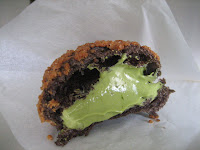
Chocolate puff with crispy top and green tea custard.


Sweet green tea tofu with red beans. This is one of my favourites.


Cookies with green tea and currants.


Matcha latte


Green tea bread with red beans.


Green tea layer cake. Between layers there is some kind of cream with red bean pieces. The cake is incredibly moist.


Green tea bun filled with red bean paste.


Green tea tiramisu served with red bean paste. Even thought not made with savoiardi it was EXTREMELY delicious, want a recipe now!


Green tea "marble" cake.


Green tea brownie with whole red beans. Was a bit too dry for a brownie but the taste was great.


Green tea madeleines.

Thursday, April 03, 2008

Lamb and mutton in China

When I think of lamb and mutton I think of UK. British know their lamb! Before coming to China I never thought of lamb and mutton as a part of Chines cuisine. But oh was I wrong! In the very west part of China there is a small minority of Uyghur people and they have contributed to the Chinese cuisine with excellent lamb and mutton dishes.

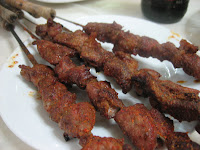
Here in Shanghai there are many Uyghur restaurants. Usually outside the restaurant there is a huge barbecue where you can buy "take away" lamb skewers (picture). Lamb skewers are seasoned with some kind of special spice, but cumin and chili powder are dominating. I cannot even explain how tasty they are.

And on the menu you can find all kind of mutton, lamb, beef and chicken dishes. Below you can see some of them.

 Lamb skewers - outside the restaurant you can buy skewers that are mixture of meat and fat. Lamb fat is very tasty. But inside the restaurant you can order lean skewers with almost no fat at all. I like better fatty ones.


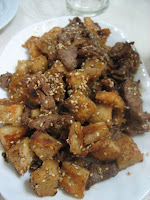
Pan fried lamb with naan bread and sesame...very very very delicious!


Mutton buns


Minced lamb with some vegetables eaten with thin pancakes.

Saturday, March 29, 2008

Pozole

I never thought I would be writing about Pozole when in China, even less making it, but here we are. Pozole is Mexican soup made of special corn called hominy and it is my favourite Mexican dish.

Main ingredients are, hominy, dried chillies and some kind of meat (pork, chicken or seafood). And when is done you garnish it with fresh avocados, lime, cilantro, radish, salad. There are many many variations of pozole, but my favorite is red pozole with chicken.

So can you imagine my happiness when I saw hominy in a supermarket (western food supermarket). I made it the very same day, but will not post a recipe this time, just wanted to let you know about pozole. And if you ever have a chance to taste it, do that, is more than delicious!

Thursday, March 27, 2008

Chinese steamed bread

First time I saw Chinese steamed bread I thought it was half-done, that you need to finish baking it in the oven. That's how much I knew about Chinese cooking. What can I say, I was a stir-fry and chow-mein person.

From a friend I found out that the bread was not at all half-done, but all done and ready to eat. The reason it was so pale was because it has been steamed and not oven baked. I could not believe it, no crust at all?! So of course I had to try it...and all I can say is that I am hooked on steaming. Not only bread (western type of bread included) but anything else that fits in my bamboo-steamer (post about it coming soon).

The steamed bread itself tastes good, despite no crust. It is more chewy, I guess because of steam. But it molds faster than oven-baked bread, again because of moisture. However, what I have been thinking about was bagels. Have to test steaming them instead of boiling in water and then oven-baking. Could be something.

Saturday, March 22, 2008

Easter chocolate eggs

I wasn't looking for a chocolate egg mold, but when I saw it at the store where I bought the moon cake molds I couldn't resist.

I have never made chocolate eggs before, I always thought it looked a bit complicated, but for some reason I thought it was time to do try it out. It was not easy, I guess is one of these things where "practice makes perfect" gives you encouragement. But it was so much worth it, egg mold is here to stay.

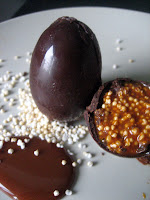
The mold is made of hard plastic and gives 9 whole eggs. Each egg half holds 2 tsp of water, so they are just perfect size, not too small not too big. What I did was, I melted chocolate, filled each half with a bit less then 1 tsp and I spread it around by moving the mold. Then I put it in the fridge until chocolate was hard and repeated the coating 3 times more, but with a brush, thought it was easier.

The tricky part was to make nice, flat, thick edges as they are important when you are putting two egg halves together. And to keep egg shells nice and shiny, next time I will wear plastic gloves.

As much as I was excited about the chocolate shells that much I was excited about the filling inside the eggs. After some creative thinking the result was eggs filled with ingredients from 3 different continents and 3 different countries.


Jasmine tea and dark chocolate ganache - tea was discovered in China and is very important in Chinese culture. There are close to 1000 different types of tea but in this chocolate egg I chose jasmine. Jasmine and dark chocolate go so well together. I infused tea with hot cream, strained it and mixed with chocolate to make ganache, wonderful!


Daim bar and milk chocolate ganache - Daim is so Swedish, so Swedish you can find it at IKEA. It is made of crunchy almond bar and covered with milk chocolate. I crushed some of it and mixed with a milk chocolate ganache, love it love it love it...


|


Amaranth and cajeta - cajeta is Mexican syrup that is made of caramelized goats milk...yes goats milk! I am lucky enough to have supply of cajeta and amaranth all year round from Mexico.


Green tea and amaranth - this one is a hit! I made white chocolate ganache, added some green tea powder (Chinese, not Japanese matcha) and mixed with some amaranth.


Tuesday, March 18, 2008

Moon cake molds

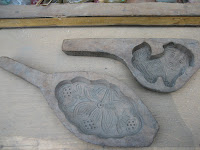
I found them, the moon cake molds! Not traditional ones made of wood (second picture), but for now these plastic ones will do just fine. I call them Shanghainese-style moon cake molds, they represent something traditional but with a modern touch, just as Shanghai does.

These wonderful square and round molds come with 8 different prints each. I still do not know what all of them mean but I am working on it. There were two different sizes, big and small, but I chose to buy the small ones. I like the idea of cookie-size moon cakes. And can you imagine green-tea cookies with one of those wonderful characters?

I already have zillion ideas for the filling (yes one of them is Nutella!) and now the only thing I need is a good recipe for a moon cake dough. Mid-Autumn festival 2008 here we come!

Friday, March 07, 2008

Kumquat and apple charlotte

Kumquats and apples go really well together. In this charlotte I was tempted to use only kumquats but thought the flavor could be too strong (can have too much of kumquats after all).
I also like to use brioche instead of bread loaf when making charlotte because I think it gives a perfect crispy/buttery/juicy combination. This recipe serves 4 individual charlottes.


Kumquat and apple charlotte
4 apples
15 kumquats
juice of one orange
1/2 dl sugar

150 gr butter
14 slices brioche (size of a bread loaf), a bit dried out
4 individual pudding molds

Peel and core the apples and cut into small pieces. Slice and seed kumquats. Melt a spoon of butter in a pan, add the fruits, orange juice and sugar and cook on a low heat for about 20 minutes. Set aside to cool a bit.

In the meantime cut the edges of the brioche and cut 4 circles that will cover the bottom of the pudding mold.Cut the rest of the brioche in 3 cm wide rectangles. Melt the rest of the butter and brush each piece of the brioche on both sides.

Put the circles on the bottom of the pudding mold and line around with the brioche rectangles. rectangles should be a bit bigger then the mold as you will seal the pudding with them. Fill the mold with the fruits and seal it.

Preheat the oven 200 C and put the molds in. To keep everything in place while baking and to get a nice shape place a heavy heatproof plate or similar on the top of the molds. Bake for about 20 minutes, take of the heavy plate and bake until the top is golden. Charlotte is best eaten while warm.