Wednesday, October 29, 2008

Pozole

Here it is, my favourite dish ever, pozole. Pozole is one of the most authentic Mexican dishes and it has everything a dish should have, if you ask me. The base is made of corn, same type as corn flour for tortillas is made of, and the rest of the ingredients vary.

In Mexico corn for pozole is sold either dried or vacuum packed (picture). Outside Mexico it is usually sold canned. Vacuum packed corn does not need to be soaked over night but it still has to be cooked for 2-3 hours until the kernels open.


After the corn is cooked, meat is added. Pozole can be made with beef, pork, chicken, seafood, or meatless. And depending on which chillies are used pozole can be red, green or white (no chili). My favourite is red pozole made with a mixture of ancho (left) and guajillo (right) chilies.

There are so many different types of pozole that in Mexico there are restaurants who only serve pozole, they are called pozolerias. A must when visiting Mexico.

Pozole
serves 4
500 gr pozole corn
400 gr chicken, mixture legs and breasts
1 onion
2 garlic cloves
2 chilies anchos
2 chilies guajillos
salt and pepper

finely chopped radish, avocado, onion, salad (4 tbsp of each)
dried oregano
lime
tostadas (oven dried or fried corn tortillas)
or
totopos (oven dried or fried corn tortilla chips)

Wash corn couple of times, put in a casserole and cook in water until it opens. Do not add any salt as that prevents corn from opening. This takes 2-3 hours. Water needs to be added from time to time. Add the meat, garlic, onion, salt and pepper. When the meat is cooked take it out, let it cool and shred it in small pieces.

Clean the chilies, soak in hot water for about 15 minutes and when soft blend in a food processor. I don't have a food processor or mortar so instead I scrape the flesh, chop it very finely and press through a strainer. Chilies are sometimes very spicy but sometimes not so much, so add them to the corn spoon by spoon.

Serve pozole in bowls, top with fresh vegetables, chicken meat and sprinkle some dried oregano. Totopos and a piece of lime on the side. Lime is squeezed over pozole just before eating.

Sunday, October 26, 2008

Bavarian potato salad

I have never liked potato salads, but thanks to the Bavarian potato salad that is different now. This potato salad is very tasty, very easy to make and with few ingredients. Just like a potato salad should be.

It is the most common side dish served with the schnitzel and it is so popular that there is even a tool for cutting the boiled potatoes in perfectly even, same size thickness (5 mm). I bought it.


Potato slicer is really not necessary if you are making salad for few people, but it has its speed-advantage when making for a crowd.

The boiled potatoes are seasoned with a light dressing made of oil, vinegar, mustard, stock, salt and pepper. The creaminess is achieved by mashing a potato and mixing it with the dressing.
I cannot wait to try this salad with new potatoes!

Bavarian potato salad

 2 side dishes
400 gr potatoes, waxy not floury
2 dl warm stock (I used chicken stock)
2 tbsp white vinegar
1 tbsp oil
1 tsp mustard (medium hot)
salt and pepper
1 medium onion, finely chopped
olive oil
bunch of chives, finely sliced

Scrub the potatoes, do not peel, and cook in salted water until done. Fry onion in some olive oil on low temperature until soft and transparent, not brown!


When potatoes are cooked peel them, mash one potato and cut the rest in slices. Made the dressing with mustard, oil, vinegar, salt and pepper. Add stock and mashed potato. Mix the dressing and fried onion with the sliced potatoes. Blend well, sprinkle with chives and serve.

Thursday, October 23, 2008

Argentine empanadas

Empanadas are made of pastry filled with meat. They can be found in Spanish speaking countries and in Argentina they are considered a national speciality. I have tried empanadas from Spain, Argentina and Mexico. Argentinian are definitely my favourite.

Every region in Argentina has its own version of the filling but the base is made of equal parts of ground beef and onion, that has been seasoned with ground paprika and cumin. All other ingredients like, potatoes, eggs, olives, raisins...differ from region to region and basically you can add them to your liking.

Another great thing about these empanadas is that they can also be baked in the oven. Usually empanadas are fried in oil but Argentinian can be baked without making them un-authentic. I was not that much interested in the pastry this time so I just bought frozen in a Latino food store here in Munich. But here is a recipe for homemade empanada pastry.

Empanadas
16 empanadas
150 gr ground beef
150 gr onion, finely chopped
1 garlic clove
1/2 tsp ground paprika (sweet)
1/2 tsp ground cumin
1 hard boiled egg, chopped
1/2 dl green olives, chopped
2 tbsp raisins
1/2 dl red pepper, chopped
olive oil

16 empanada pastry discs (12 cm)

Fry onion and garlic in some oil on low temperature until glossy and transparent, takes about 10 minutes. Add ground paprika and cumin, fry 2-3 minutes. Add olives, raisins and pepper, fry 5 minutes more. Switch off the cooker, add meat, fry just shortly, as soon as it is not red anymore take off the cooker. The meat should not be cooked completely as it will cook again in the oven for another 15-20 minutes. Add egg, season with salt and pepper,and let the filling cool down a bit. If it is too hot it might melt the butter-based pastry.

To fill empanadas take one pastry disc, place one tablespoon of filling in the middle. Carefully close empanada, this is probably the hardest part. Press two edges of emapanada well so that nothing comes out. Empanada should look like a half moon and have an dough edge of about 2cm. To make a nice spiral edge, start by folding a corner of empanada inwards, press firmly, and continue folding the dough until you reach the other corner.

Place empanadas on a baking sheet, paint with a beaten egg and bake in preheated oven, 200C, for 15-20 minutes.

Monday, October 20, 2008

Boskoop apples

Recently I tried apple fritters made with the most amazing apples ever, Boskoop apples. These fabulous apples almost transform into apple sauce when cooked, they are simply melting away.
I just couldn't wait to make my favourite apple cake with these amazing apples from the Netherlands.

I used kamut flour in the dough and kamut semolina in the filling. Kamut semolina makes sure that juice from apples doesn't make the cake wet and soggy. Vanilla and lemon in the dough are a must.

I made the cake in my cast iron pan, works perfectly.


Apple cake
75 gr butter
2,5 dl kamut flour
4 tbsp sugar
1 egg
1\2 tsp baking powder
few drops lemon oil (or some lemon zest)
seeds of 1 vanilla pod
1 dl sliced almonds

6 Boskoop apples, peeled and thinly sliced
2 tsp ground cinnamon
4 tbsp sugar
1/2 dl water
2 tbsp kamut semolina

Rub butter and flour until you get coarse crumbs. Add sugar, baking powder, egg, lemon oil, vanilla and mix quickly. Wrap in the foil and put in the fridge for at least 30 minutes, the dough needs to get chilled.

In the meantime, put the sliced apples, cinnamon, sugar and water in a pan and cook for about 10 minutes. Apples should get a bit soft and loose some of their water. Let the apples cool down a bit.

Cover the bottom of the pan with the sliced almonds. Divide the dough in two parts. My iron cast pan is about 22 cm in the bottom and 25 cm higher up so I take a little bit less dough for the bottom and little bit more for the cover.
Put the smaller disc over the almonds, sprinkle semolina over the dough and spread the apple filling over semolina. Cover with the other dough disc and bake in the preheated oven, 180C for about 25 minutes.

Let the cake cool down for about 10 minutes. Run a knife around the edges to make sure that nothing is stuck. Invert on a plate and cut first when it has cooled down to warm.


Thursday, October 16, 2008

Oktoberfest

City of Munich is very famous for its annual Oktoberfest. Although it did not start as a beer festival, almost 200 years ago, today the festival is all about beer.
There are 6 big breweries and each have huge tents where beer in 1 litre mugs is served, gigantic!

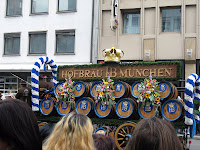
On the same day as the Oktoberfest starts there is a parade of all breweries and other companies that take part in the Oktoberfest.


The next most important thing to the beer is of course the food. Typical Bavarian food like, sausages, schnitzels, pretzels, knödels, grilled chicken, roast pork...can also be found in the beer tents. Outside the the tents, that covers a huge area, you can buy even more food, but no 1 litre mug beer. On the right picture below is ox-roast with fried onions.


One important thing to remember is that although it is called Oktoberfest, these days it starts mid September and lasts for 16 days.

Wednesday, October 08, 2008

Danube wave

I love food that tells a story, and I believe that this cake is one of them. In German it is called "Donauwelle", which means "Danube wave".

Danube is Europe's second longest river (the longest is Volga river) that runs through 10 countries. Two of these ten countries are German speaking. The cake it self resembles waves and although German Wikipedia claims that there is no connection between this cake and the Danube river I choose to believe that there is a connection.

I believe that once upon a time there was a very creative person who liked to bake and who enjoyed the beauty of the Danube river. One windy day she (he) was sitting on the bed of the Danube, probably under a cherry tree, and the idea for the "Danube wave" cake was born.

This cake is really easy to make and the result is amazing. Chocolate and cherries just cannot be wrong. And then all the waves, wonderful.

The cake batter is a pound cake in two colours, light and dark. I used my brownie baking pan (22x22cm) and thought that pound cake made of 100 gr of each ingredient (sugar 70 gr) would be enough, but I believe next time I will increase to 150 gr of each ingredient. I used only 100 gr butter in the butter cream but next time I will use only custard.

I have also started replacing wheat flour with kamut flour when baking and it really worked excellent in this recipe. Kamut flour is yellowish which makes it look even prettier.


Donauwelle
2 eggs (approx. 110 gr)
100 gr butter
70 gr sugar
100 gr kamut flour
1/2 tsp baking powder
2 tbs cacao powder
300 gr sour cherries in jar

4 dl vanilla custard

100 gr butter

150 gr chocolate
3 tbsp cream

Put the cherries in a sieve. Beat sugar and butter until fluffy, add eggs one at the time, beating well after each egg. Add flour and baking powder and mix very shortly. Divide in two equal parts and add cacao to one part. Mix and if batter is too thick add some milk.

Spread evenly light batter in the pan, spread cacao batter over it. Every 1 cm put one cherry and press down a bit. Bake on 160C for about 25 minutes. Take it out of the oven and let cool completely.

Cream the butter and add vanilla custard, mix well and spread evenly over the cake. Chop the chocolate, heat the cream and add it to the chocolate. Blend well until chocolate is melted. Let it cool a bit in case it is hot so that it doesn't melt the butter cream. Spread on the top of the cake and with a fork make waves.

Waves are best visible if you cut in the middle of a cherry row.

Sunday, September 28, 2008

Celeriac schnitzel

Yes there is vegetarian schnitzel too. And I didn't came up with the name, Germans call it like that.

Celeriac is a root vegetable and it is relative of celery, but looks completely different. Raw celeriac is a little bit milder in taste than celery, and when cooked it becomes a bit sweet and nutty in taste. I really, really like it.

I don't like celery so I probably would not have given a chance to celeriac if it wasn't for my curiosity. That it was called schnitzel helped as well.

Celeriac schnitzel is coated with flour, eggs and breadcrumbs just like meat schnitzel. But it needs to be fried on low temperature as it takes some time until celeriac turns soft. I fried it in some olive oil.


Wednesday, September 24, 2008

Schnitzel

Bavaria (south-east region in Germany) is the kingdom of schnitzels. And right now I happen to live in this kingdom of schnitzels. They are everywhere, meat in general for that matter. Schnitzel is originally from Austria and Bavaria used to cover part of Austria, so I guess the schnitzel tradition came along as well.

Original Vienna schnitzel is made of veal but these days they can be made of pork or chicken as well. When made of pork Germans do not call them Vienna schnitzel but "Viennese style schnitzel". Fine and fair distinction.

The meat for schnitzel needs to be around 5 millimetres thick, then it is covered in flour, dipped in beaten eggs and last in dried breadcrumbs. It is fried in lard or oil (lots of it, needs to swim in it). I fry schnitzels in clarified butte and it works like a charm. 

Schnitzels are usually eaten with potato salad and some lemon juice is squeezed on top of the schnitzel. Austrian version adds also some lingonberry as well (just like Swedish meatballs). When it comes to the Bavarian potate salad it really has become my favourite potato salad. It is creamy but has no mayonnaise or some other diary product, wonderful. Recipe coming soon!

Sunday, September 21, 2008

Mushroom tacos

This is the best recipe for non-meat tacos. I would normally say vegetarian but I cannot call tacos vegetarian, no no, it just doesn't feel right. I do love vegetables, a lot, but tacos are all about meat. Just not these tacos.

Anyway, I found the recipe in this book and have only changed the way of cooking the mushroom filling. Just to make sure that all flavours develop nicely I added other ingredients to the mushrooms one at the time and not all at once as the book suggests.

Mushroom tacos
500 gr mushrooms, any type you like, cut in smaller pieces
1\2 dl olive oil
4 garlic cloves, finely diced
3 small onions (mild type, I used shallot), finely diced
2 tbsp dry white wine
2 medium tomatoes, diced
2 jalapeños, discard white pith, core, seeds and dice finely
1 dl coriander, chopped
salt
corn tortillas

Heat the oil and add mushrooms. Fry until they loose their water, add garlic, onion and chili. Cook until mushroom and onions get bit of colour. Add tomatoes and wine. Cook another 2-3 minutes. Add coriander and salt. Serve in hot corn tortillas.

Wednesday, September 17, 2008

Corn flour for tortillas

Corn (maize) is native to Mexico and tortillas made of corn flour have been eaten as bread since ancient times. The flour for tortillas can be made of white, yellow or blue corn. It is probably the most colourful flour ever, just like Mexico is.
Before corn is ground it is soaked in lime water, which gives it a special character and taste, so it is completely different from European type of corn flour (polenta & Co.). I get my corn flour from Mexico and this is how white, yellow and blue corn flour looks like:

It was just recently I found out about yellow corn flour for tortillas (the white and blue tortillas are the most common one). To make tortillas you only need to add water and salt, mix and voilà:

To make beautiful round tortillas it is best to use tortilla machine, but of course rolling pin works as well. And after couple of minutes in a cast iron pan tortillas are ready!

There is a small difference in taste between the colors; blue and yellow one are a bit stronger in taste and white ones are milder. My favourite are blue ones, taste is great and they look so cool.
The tortilla basket is called tortillero and it keeps tortillas warm. The one I have doesn't only look cute but it is also isolated with styropor, keeps tortillas warm perfectly.