Monday, April 27, 2009

White asparagus

For me white asparagus is more like another vegetable than a relative to the green asparagus. Or maybe is the other way around, I do not know. In any case they are very different in taste, green one being far superior in taste.
White asparagus grows under the soil so lack of sun makes it white and its skin needs to be peeled as well. It tastes the best when is boiled and served with pan fried new potatoes and smoked ham.

White asparagus
serves 2
500 gr white asparagus
pinch of salt and sugar
1 tbsp butter
10 small new potatoes
3 tbsp olive oil
salt and pepper
8 slices smoked ham

Start with peeling the asparagus, save the skin. Cut of the hard ends of the asparagus, save them as well. Put the asparagus skin and ends in a sauce pan, add pinch of salt and sugar, a tablespoon of butter, boil, turn of the heat end let sit for about 20 minutes.

Cut the young potatoes in half and pan fry in olive oil on low heat until cooked, 30-40 minutes. Add salt and pepper.

Strain the asparagus liquid, discard the skins and ends, add the asparagus and cook for about 15 minutes. Strain and serve with potatoes and ham.

Monday, April 20, 2009

Green asparagus

Germans are mad about asparagus. And at this time of the year everything in this country is about asparagus (Spargelzeit).
Every year there are asparagus festivals that celebrate the "royal vegetable", as Germans call it.
I was watching on the news that at one of the festivals young beautiful woman was chosen to be "Asparagus Queen", and she got the honour of harvesting the first asparagus of the year.

A colleague of mine also told me that in her family asparagus is served every single Saturday during the season (April-June).

We all might be obsessed with something but here we got a whole nation being obsessed with a great vegetable like asparagus. It is wonderful to see this! Reminds me a bit of Swedish strawberry season.

White asparagus is the favourite asparagus of German. My favourite is green and I am firmly convinced that the best way to prepare green asparagus is when it is cooked with olive oil in a cast iron pan and when it is served with smoked salmon and sourdough bread.

Green asparagus
serves 2
500 gr green asparagus
3 tbsp olive oil
6 slices smoked salmon
2 slices sourdough bread
salt and pepper

If the asparagus is fresh-fresh (check the cut at the end) it does not need to be peeled. In other case, peel the asparagus, heat the olive oil in the cast iron pan (has to be cast iron) and cook the asparagus on low heat until soft to your liking, about 20 minutes. Keep on turning asparagus so that all sides get nicely cooked. When done, salt and pepper. Serve with smoked salmon and your favourite sourdough bread.

Saturday, April 11, 2009

Slovenian buckwheat žganci

I have been to Slovenia couple of times and I love that country. People are amazing, the country is beautiful and it has everything you could ask for: Alps,valleys, lakes, rivers and sea.

When it comes to the cuisine, it is delicious, diverse and very Slovenian. The diversity comes with the influence from Austria, Italy and the Balkans and makes Slovenian cuisine quite unique.

The buckwheat is typical for the region, as well as it is for Italian and Austrian regions in the neighbourhood. I got interested in this dish because it is made with buckwheat flour only, without addition of any other flour, eggs, milk. In fact buckwheat flour is the only ingredient.

And the way this dish is prepared is the most insane way of cooking. Basically the dish is made by pouring buckwheat flour in salted boiling water. Sounds simple but it is not as it is a bit tricky to get the flour to form small lumps. But after couple of failures I finally got it right.

This dish is also made in Austria where is called Heidensterz, but it is prepared a bit differently. The flour is first roasted in a pan and then water is slowly added. I have not tried to make it this way but it sounds a bit more simple than the Slovenian version.

Traditionally žganci are served with sauerkraut, sausages or milk, here I added them to olive oil, garlic, parsley and red chili (aglio, olio and peperoncino). I believe žganci can be combined with any kind of sauce, so they will replace my usual wheat-pasta in many dishes.

Ajdovi žganci
serves 2
4 dl buckwheat flour

1,2 l water
1 tsp salt

aglio, olio e peperoncino
4 tbsp olive oil
4 garlic cloves
2 red serrano chillies
4 tbsp parsley
some parmesan
black pepper

Boil the water in a saucepan, add salt and take off the heat. Add the flour, all at once. Shake the saucepan until all flour is covered with water. A big lump will form.

No matter how much tempted you feel to grab a spoon and blend everything, do not do it, as everything could turn into a smooth looking buckwheat-polenta. Part of the flour that does mixes completely with the water will sink to the bottom of the saucepan and get pretty much stuck to it. I have not find a way to avoid this.

Make a whole in the middle of the lump, it will brake in smaller lumps, shake again the saucepan until all flour is covered with water.
Put the saucepan back on the medium heat and cook for about 20 minutes. The liquid will become a bit thicker and lumps will soak some of the water.

Drain as much liquid as you can, and save it in a bowl. With help of a spoon cut through the lumps until you get smaller lumps.
If the mixture is to much dry add some of the drained liquid. Cover with a lid and let stand on a turned off cooker for about 15 minutes.

For the sauce chop finely garlic, chili and parsley. Heat the oil in a pan, add garlic and chili and cook until garlic is slightly golden. Add parsley and žganci, with a help of two spoons keep on ¨cutting¨ through žganci so that the lumps do not stick to each other. Cook for about 10 minutes on low heat. Serve with parmesan and black pepper.

Monday, April 06, 2009

Thyme chocolate


Chocolate and thyme, I never thought that this combination could be so delicious. And addition of flax seeds, which are rich in omega 3, makes this chocolate a nice new addition to the ever expanding world of chocolate.

Monday, March 30, 2009

Rhubarb

To me arrival of the rhubarb means spring is finally here! There are two different types of rhubarb that I know about and that I use differently.
The rhubarb on the left side on the picture is the most common one and as it has some woody strings I usually peel it, cut it in smaller pieces and use in pies and cakes. I also freeze this rhubarb for later use.

The rhubarb on the right side is from my parents garden in Sweden. It has shorter stalks, strings are not woody and its flesh is so delicate that you do not need to do much to it as it is perfect just like it is. The young tender stalks of this rhubarb can also be eaten fresh.
When I cook it I usually dip it in sugar and bake covered in the oven for about 15-20 minutes, just until soft, and serve with mascarpone, ricotta or yogurt. Here in Germany there is strawberry quark that is perfect to serve with this baked rhubarb.

Tuesday, March 24, 2009

Semolina soup dumplings

These soup dumplings were one of my favourite food when I was a kid, but I cannot remember when I ate them last. Luckily they are very popular in this part of Europe so I have kind of rediscovered them.

Something that was complete new to me was that here in Germany these dumplings can even be prepared as a dessert. I just bought some buckwheat semolina and will definitely give it a try.

Semolina soup dumplings
serves 4
2,5 tbsp soft butter
1 egg
1 dl semolina (I used kamut semolina)
pinch of fresh grated nutmeg
1/2 tsp salt
1,5-2 litres chicken soup
finely sliced chives

Beat the butter until creamy, add egg and beat well. Add semolina, salt and nutmeg. Blend well and let rest 20 minutes.

Boil the chicken soup and take off the heat. To shape dumplings take 2 teaspoons, put some dough in the spoon that is in your right hand (if you are right handed). Slide it off on to the empty spoon and you will get one semi-fine side (picture 2 and 3, first row).


Now with your right hand spoon slide of the dough again (picture 1, second row). Turn your hand and slide off the dumpling on to the left spoon (picture 2, second row) and your dumpling is ready (picture 3, second row). The dough is enough for 16 dumplings.
Slide the dumplings into the hot chicken soup. When all dumplings are done put the saucepan back on the cooker and cook on the low heat for about 20 minutes. The dumplings double in size so make sure the saucepan is big enough. Pour the dumplings into individual bowls, sprinkle some chives and serve.

Wednesday, March 18, 2009

Fresh zucchini salad

This is a perfect salad to welcome the spring! It is fresh, fabulous and you just want more of it. Feel free to make it with different vinaigrette.

Fresh zucchini salad
serves 2
2 small zucchinis
juice of 1 lime
3 tbsp olive oil
1 red chili, finely sliced
1 tbsp chopped coriander
10 cherry tomatoes, halved
salt and pepper
bit of cress

Mix oil, lime juice, coriander, chili, salt and pepper. Slice the zucchinis with a potato peeler and mix with the vinaigrette. Let sit for 10 minutes. Add halved tomatoes, top with the cress and serve.

Sunday, March 15, 2009

Bramley apples

I have been curious about Bramley apples for a very long time, and finally I got a chance to cook with them. Bramley apples are British and almost all UK recipes, where apples are included, call for Bramley apples.

They even have their own web-page where they are described as "superior to other dessert apples when cooked". The web-page has some great recipes as well. So what can put these apples to the test if not good old apple strudel!


The strudel turned out excellent and Bramley apples were amazing. They are melting away and the taste is wonderful. Bramley apples have passed the test. But all of you who are not able buy them, do not worry, Boskoop apples, which are easier to find outside the UK are as good as Bramley.

Apple strudel serves 64-5 apples (500 gr when peeled and cored)
2 tbsp lemon juice
1,5 dl breadcrumbs
65 gr butter
1/2 dl sugar
1 dl raisins
3 tbsp rum
1 dl chopped walnuts
1/2 tsp cinnamon

homemade strudel dough or phyllo

If you are doing your own strudel dough start with it and let it rest while you are preparing the filling. Peel the apples, cut them in quarters, core and slice in thin slices. Add lemon juice, sugar, cinnamon to the apples and set aside. Heat the rum in a saucepan and add raisins. Take off the heat and set aside.

Roll and stretch out the strudel dough until thin. I find it easier to handle the dough if I let it dry a bit while I am preparing the breadcrumbs.

Melt the butter in a pan. Take away 4 tbsp of melted butter that you will use for brushing the strudel later on. Add the breadcrumbs to the pan and fry until golden. Should look something like this:

Add raisins and walnuts to the apples. Brush the strudel dough with butter. Sprinkle breadcrumbs all over the dough, leaving 5 cm edge all around. Spread the apples only over half of the dough. Fold in the edges on the sides, fold in the dough on the short side.

With the help of the cloth start rolling the strudel until you have used all the dough.


With the help of the cloth put the strudel on a baking sheet, brush with butter and bake in preheated oven 200 C for about 35 minutes.

Strudel is traditionally sprinkled with powdered sugar and served with vanilla sauce. I serve the strudel just like it is, simple and delicious.

Thursday, March 12, 2009

Spring is coming...

...asparagus, rhubarb, asparagus, rhubarb, rhubarb, asparagus, rhubarb, asparagus, rhubarb, asparagus, rhubarb, asparagus, rhubarb, asparagus...I cannot decide which one I am looking forward more...rhubarb, asparagus, rhubarb, asparagus, rhubarab, rhubarb, asparagus, rhubarb, asparagus, rhubarb, asparagus, rhubarb, asparagus, rhubarb...

Sunday, March 08, 2009

White Stilton

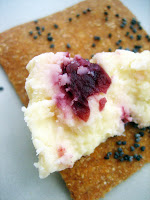
It looks like a cheesecake but it is not. It is a piece of English white Stilton cheese dotted with cranberries. I love it. It is creamy but at the same time it crumbles easily, the taste is mild and cranberries are slightly sweet. And on a piece of your favourite cracker it becomes a true English delicacy.


Crackers
45 crackers, 5x5 cm
1 dl kamut flour
3 tbsp buckwheat flour
1 tbsp olive oil
pinch of salt
4 tbsp of water

fresh or dried oregano, thyme, rosemary...


2 tsp poppy seeds (or sesame, caraway, fennel, coriander seeds...)


Preheat oven to 200 C. Mix the flours with salt, add oil and water (herbs if using) and kneed until you have smooth dough. Roll into a square 35x35 cm. Cut into smaller squares, 5x5 cm, brush lightly with water, sprinkle the seeds, transfer the crackers on a baking sheet and bake until golden, about 10 minutes.