Saturday, March 29, 2008

Pozole

I never thought I would be writing about Pozole when in China, even less making it, but here we are. Pozole is Mexican soup made of special corn called hominy and it is my favourite Mexican dish.

Main ingredients are, hominy, dried chillies and some kind of meat (pork, chicken or seafood). And when is done you garnish it with fresh avocados, lime, cilantro, radish, salad. There are many many variations of pozole, but my favorite is red pozole with chicken.

So can you imagine my happiness when I saw hominy in a supermarket (western food supermarket). I made it the very same day, but will not post a recipe this time, just wanted to let you know about pozole. And if you ever have a chance to taste it, do that, is more than delicious!

Thursday, March 27, 2008

Chinese steamed bread

First time I saw Chinese steamed bread I thought it was half-done, that you need to finish baking it in the oven. That's how much I knew about Chinese cooking. What can I say, I was a stir-fry and chow-mein person.

From a friend I found out that the bread was not at all half-done, but all done and ready to eat. The reason it was so pale was because it has been steamed and not oven baked. I could not believe it, no crust at all?! So of course I had to try it...and all I can say is that I am hooked on steaming. Not only bread (western type of bread included) but anything else that fits in my bamboo-steamer (post about it coming soon).

The steamed bread itself tastes good, despite no crust. It is more chewy, I guess because of steam. But it molds faster than oven-baked bread, again because of moisture. However, what I have been thinking about was bagels. Have to test steaming them instead of boiling in water and then oven-baking. Could be something.

Saturday, March 22, 2008

Easter chocolate eggs

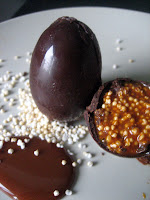
I wasn't looking for a chocolate egg mold, but when I saw it at the store where I bought the moon cake molds I couldn't resist.

I have never made chocolate eggs before, I always thought it looked a bit complicated, but for some reason I thought it was time to do try it out. It was not easy, I guess is one of these things where "practice makes perfect" gives you encouragement. But it was so much worth it, egg mold is here to stay.

The mold is made of hard plastic and gives 9 whole eggs. Each egg half holds 2 tsp of water, so they are just perfect size, not too small not too big. What I did was, I melted chocolate, filled each half with a bit less then 1 tsp and I spread it around by moving the mold. Then I put it in the fridge until chocolate was hard and repeated the coating 3 times more, but with a brush, thought it was easier.

The tricky part was to make nice, flat, thick edges as they are important when you are putting two egg halves together. And to keep egg shells nice and shiny, next time I will wear plastic gloves.

As much as I was excited about the chocolate shells that much I was excited about the filling inside the eggs. After some creative thinking the result was eggs filled with ingredients from 3 different continents and 3 different countries.


Jasmine tea and dark chocolate ganache - tea was discovered in China and is very important in Chinese culture. There are close to 1000 different types of tea but in this chocolate egg I chose jasmine. Jasmine and dark chocolate go so well together. I infused tea with hot cream, strained it and mixed with chocolate to make ganache, wonderful!


Daim bar and milk chocolate ganache - Daim is so Swedish, so Swedish you can find it at IKEA. It is made of crunchy almond bar and covered with milk chocolate. I crushed some of it and mixed with a milk chocolate ganache, love it love it love it...


|


Amaranth and cajeta - cajeta is Mexican syrup that is made of caramelized goats milk...yes goats milk! I am lucky enough to have supply of cajeta and amaranth all year round from Mexico.


Green tea and amaranth - this one is a hit! I made white chocolate ganache, added some green tea powder (Chinese, not Japanese matcha) and mixed with some amaranth.


Tuesday, March 18, 2008

Moon cake molds

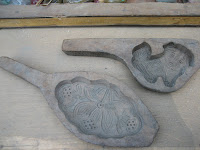
I found them, the moon cake molds! Not traditional ones made of wood (second picture), but for now these plastic ones will do just fine. I call them Shanghainese-style moon cake molds, they represent something traditional but with a modern touch, just as Shanghai does.

These wonderful square and round molds come with 8 different prints each. I still do not know what all of them mean but I am working on it. There were two different sizes, big and small, but I chose to buy the small ones. I like the idea of cookie-size moon cakes. And can you imagine green-tea cookies with one of those wonderful characters?

I already have zillion ideas for the filling (yes one of them is Nutella!) and now the only thing I need is a good recipe for a moon cake dough. Mid-Autumn festival 2008 here we come!

Friday, March 07, 2008

Kumquat and apple charlotte

Kumquats and apples go really well together. In this charlotte I was tempted to use only kumquats but thought the flavor could be too strong (can have too much of kumquats after all).
I also like to use brioche instead of bread loaf when making charlotte because I think it gives a perfect crispy/buttery/juicy combination. This recipe serves 4 individual charlottes.


Kumquat and apple charlotte
4 apples
15 kumquats
juice of one orange
1/2 dl sugar

150 gr butter
14 slices brioche (size of a bread loaf), a bit dried out
4 individual pudding molds

Peel and core the apples and cut into small pieces. Slice and seed kumquats. Melt a spoon of butter in a pan, add the fruits, orange juice and sugar and cook on a low heat for about 20 minutes. Set aside to cool a bit.

In the meantime cut the edges of the brioche and cut 4 circles that will cover the bottom of the pudding mold.Cut the rest of the brioche in 3 cm wide rectangles. Melt the rest of the butter and brush each piece of the brioche on both sides.

Put the circles on the bottom of the pudding mold and line around with the brioche rectangles. rectangles should be a bit bigger then the mold as you will seal the pudding with them. Fill the mold with the fruits and seal it.

Preheat the oven 200 C and put the molds in. To keep everything in place while baking and to get a nice shape place a heavy heatproof plate or similar on the top of the molds. Bake for about 20 minutes, take of the heavy plate and bake until the top is golden. Charlotte is best eaten while warm.

Sunday, February 24, 2008

Lantern Festival

Lantern Festival falls exactly 15 days after the Chinese New Year and it ends the celebration of the new year. Lanterns are hung all over the city and sticky rice dumplings (yuanxiao) served in sweet (or savoury) soup are eaten.
The sweet soup is usually made with rock sugar and ginger, but I used slab sugar and kumquat, so if you want to impress your Chinese friends don't do as I did, although the soup was very delicious.

Slab sugar is a Chinese type of sugar that is made of white sugar, brown sugar and honey. It gives a bit of brownish color but it doesn't have a strong flavor.


Yuanxiao-sticky rice dumplings

1 dl sticky rice flour
1 tsp oil
1/2 dl hot water
1 dl red bean paste for the filling

4 dl water
100 gr slab sugar (1 stick)
10 kumquats, sliced and seeded

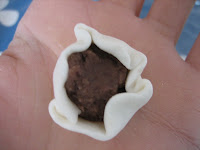
Mix flour, oil and water with a spoon until the dough comes together. Let rest for 15 minutes. The sticky rice flour lives up to its name when you mix it with water, the dough is incredibly sticky. To be able to work with it you need to sprinkle the dough with sticky rice flour so that it doesn't stick to your hands. Divide the dough in 10 pieces, flatten each piece with a slightly thicker center and put a bit of red bean paste in the middle, close carefully.

Put water and sugar in a sauce pan and simmer until sugar melts. Add kumquats and simmer for 10 minutes. Set aside.

In another pan boil 1 liter of water and boil dumplings until they float on the surface. Put couple of dumplings in a small bowl together with the kumquat soup. Serves 2-3.

Thursday, February 14, 2008

A perfect Valentine's Day cake

This is a cake that has it all: chocolate, hazelnuts and meringue! To share it with the one you love is all you need for a perfect Valentine's Day. Happy Valentine's!

Sunday, February 10, 2008

Chinese New Year

Happy New 4706, the year of the Rat! Chinese New Year is the most important holiday in China. The year of the Rat started on February 7th and it was a real pleasure to see how it is celebrated here in China. Not surprisingly food is quite central in the celebration, it is all about cured meats, dried fruits and Reunion Dinner. The dinner on the New Years Eve is called "Reunion Dinner" and as the name implies it is a dinner when family reunites.

Some of the traditional dishes served at Reunion Dinner are: dried goose, clay pot, dumplings, boiled chicken, stewed pork leg, jellyfish, bamboo shots with meat, 8 treasure sticky rice, new year cake, red dates in honey, etc...
One dish that is particularly popular here in Shanghai is the "New year cake with Shanghai pak choy". New year cake it self is not a sweet cake as you might think, it is made of glutinous rice flour and it can be used in both sweet and savoury dishes. Before coming to China I was not familiar with the new year cake, but here it is sold vacuum-packed all year round. New year cake symbolizes "a prosperous new year".

Shanghai pak choy looks a bit different than the regular pak choy. It is light green and leaves are bit wider, but the taste is quite the same. Its meaning in Shanghainese dialect is " getting rid of all worries". A double serving please.

So here comes a recipe for a prosperous new year where all worries will be out of the way.

New Year Cake with Shanghai Pak Choy

450 gr new year cake (1 pack)
200 gr pork, cut in small stripes
300 gr pak choy

pinch of salt and sugar
1 tbsp soy sauce
1/2 tbsp shaoxing wine (Chinese cooking wine)
piece of ginger, chopped

some oil
salt and pepper
1 tsp sesame oil

Marinate pork and let stand for 30 minutes. Stir fry until almost done, 3-4 min, remove and set aside. Add some oil to the wok and stir fry new year cake for couple of minutes until soft. Add pak choy, salt and pepper, stir fry for a 1-2 min, add pork and heat through. Drizzle with sesame oil and serve.

Tuesday, January 29, 2008

Kumquat

It is kumquat season and is raining kumquats here. I love it, am totally obsessed. Kumquat is native to China and it is a very much appreciate fruit, especially during the Chinese New Year as it symbolizes "prosperity". Small kumquat plants are sold on the markets and are used as decoration during the New Year celebration.

The fresh kumquat it self is delicious, but it can do magic when used in cooking. In this recipe I mixed candied kumquat with amaranth (another obsession of mine) and white chocolate. So simple but so fantastic! First you need to candied kumquats, which is very simple but takes time as the kumquats need to dry for about 2 days after they have been cooked. I did not use lots of sugar as the white chocolate is quite sweet.


Candied kumquats
10 kumquats
2 dl water
0,5 dl sugar

Wash and then slice kumquat. Discard the seeds. Heat the water and sugar, add sliced kumquat and simmer 20 - 30 minutes. Spread kumquat over baking paper and let it air-dry for a day or two.


Candied kumquat and amaranth

Melt some white chocolate (be careful as white chocolate does not like it too hot), add candied kumquat and popped amaranth. Shape it nicely, decorate with some more candied kumquat and let cool.

Sunday, January 20, 2008

Fresh water chestnut

This is how fresh water chestnut looks like. Before coming to China I have never seen or eaten fresh water chestnut, only canned one. But here in China you can find the fresh one everywhere, as it is a Chinese/ South East Asian vegetable.
The skin is very thin and soft and it is easily peeled off. The white inside has a bit different crunchiness then the canned water chestnut has. The fresh ones reminds a lot of eating green apple. And the colour is also more milk-white, it looks wonderful in dishes.