Tuesday, January 29, 2008

Kumquat

It is kumquat season and is raining kumquats here. I love it, am totally obsessed. Kumquat is native to China and it is a very much appreciate fruit, especially during the Chinese New Year as it symbolizes "prosperity". Small kumquat plants are sold on the markets and are used as decoration during the New Year celebration.

The fresh kumquat it self is delicious, but it can do magic when used in cooking. In this recipe I mixed candied kumquat with amaranth (another obsession of mine) and white chocolate. So simple but so fantastic! First you need to candied kumquats, which is very simple but takes time as the kumquats need to dry for about 2 days after they have been cooked. I did not use lots of sugar as the white chocolate is quite sweet.


Candied kumquats
10 kumquats
2 dl water
0,5 dl sugar

Wash and then slice kumquat. Discard the seeds. Heat the water and sugar, add sliced kumquat and simmer 20 - 30 minutes. Spread kumquat over baking paper and let it air-dry for a day or two.


Candied kumquat and amaranth

Melt some white chocolate (be careful as white chocolate does not like it too hot), add candied kumquat and popped amaranth. Shape it nicely, decorate with some more candied kumquat and let cool.

Sunday, January 20, 2008

Fresh water chestnut

This is how fresh water chestnut looks like. Before coming to China I have never seen or eaten fresh water chestnut, only canned one. But here in China you can find the fresh one everywhere, as it is a Chinese/ South East Asian vegetable.
The skin is very thin and soft and it is easily peeled off. The white inside has a bit different crunchiness then the canned water chestnut has. The fresh ones reminds a lot of eating green apple. And the colour is also more milk-white, it looks wonderful in dishes.

Saturday, January 12, 2008

Red-bean paste


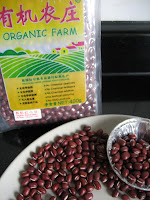
Being introduced to sweet red beans you can find the recipe for the wonderful red-bean paste here . I used white granulated sugar but a bit less of it and it worked fine.

On the picture you can see what the beans look like. They are very tiny and obviously there is a Chinese (hong-dou) and Japanese (adzuki) version but I think they are the same beans as Japanese use them in sweets as well. The paste it self is wonderful, it does have a hint of beans but is not like it reminds of chili con carne. Here I used it in crepes but I can see so much more potential here!


Sunday, January 06, 2008

The chocolate of China

Red-bean is Chinese chocolate. Not because red-bean tastes anything like cacao-bean, as we already know, but because red-bean is used the same way chocolate is used in the western countries. Yes red-beans are eaten sweet..and it tastes delicious! My first encounter with sweet red-bean was in the moon cakes and I knew immediately that I needed to find out more about it. And where do u start if not at bakeries :-).

Here below you can see some typical red-bean sweets that I found in different bakeries here in Shanghai. The most commonly red-beans are made into a sweet paste. They are boiled, mashed and mixed with sugar and some oil. But sometimes they are just boiled, mixed with sugar syrup and used in different pastries, soups, cakes, as you can see below.


Steamed bun with red-bean paste. This is the most common bun with red-bean paste and is sold all over Shanghai, from bakeries to small street vendors. I will write more just about steamed bread later on.


Red-bean paste is stuffed inside a bread slice and fried. Ends are dipped in white and black sesame.


 Sweet buns filled with red-bean paste and sprinkled with black sesame.


Red-bean paste is thinly spread between dough layers.


I thought this bun was with red-bean, it had a character for bean in its name, so you cannot blame me, but I guess the rest of the characters said "big black bean" :-). I have never before seen that big black beans, they were delicious too but are not that common.


Green-tea mousse with whole red-bean on top. The combination green-tea and red-beans is very common as well. Later on I will write more about it.


Yes, there is red-bean to drink...


... and to eat as sweet soup together with some kind of jelly.

Friday, November 02, 2007

Mooncakes

Mooncakes are traditional Chinese cakes eaten during the Mid-Autumn festival (also called Moon festival). This year Moon festival was celebrated on September 25th because it is believed that the moon is supposed to be fullest on this day.

And it is reason enough to celebrate it with you family and of course some mooncakes. This year I was lucky enough to experience Moon festival here in China.

Mooncakes are made in traditional molds and on the top of each one it says what they are filled with. Filling is surrounded by thin dough made of wheat flour. I bought a box of moon cakes that had 12 pieces with 6 different fillings.
Up from the left: coconut, red bean, mung bean
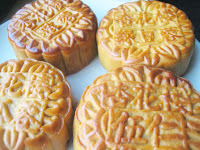
Down from the left: lotus, papaya, nuts and kernels

They are soft cakes, sweet but definitely not too sweet. One of the goals during my stay here in China is to find a good moon cake recipe and to buy moon cake-molds. Which is not quite simple as it sounds, as most Chinese people around here are buying moon cakes already done. My Chinese friend told me that today you can even buy a European version of the moon cake. I kindly asked her what was exactly a European version of the moon cake, and she said: Moon cake filled with chocolate!

As soon as she said it I got a picture and I loved it! But then a true European woke up in me and said: “Moon cakes with Nutella”. I do not know if you would be able to call them moon cakes anymore but I am sure they would do an excellent cake.
I general I think people should dare to mess with traditional cakes a bit more. I would prefer a re-invented traditional cake than a copy of a cake. The Sacher cake is probably the most copied one and at the same time the worst copied cake of them all. Probably because Austrians are not willing to share the recipe but in any case I am tired of seeing all Sacher-copies.

Here in Shanghai I have seen:”Tiramisu with Green Tea”. I have not tried it yet but I love the idea. It is Tiramisu but the name let you know that you should not expect the traditional one. More of that please and let the world know!

Friday, August 31, 2007

Guacamole with pomegranate


This is my favourite guacamole recipe: guacamole with pomegranate. The deliciously fresh taste of avocados and lime is accompanied by pomegranate and its wonderful crunchiness and sweetness, love it. Just make sure that the pomegranate you use is sweet, as a sour pomegranate and lime can make it too sour.

Guacamole can be varied with corn, different chili peppers, nuts, watermelon etc., but it always has the same base with avocados, lime, onion and cilantro. And it never ever, I repeat, never ever contains cream or any kind of diary product. That is, if you want the original Mexican version called Guacamole.

The chips, called “totopos” in Mexico, are made of tortillas that are dried in the oven or fried in the oil until crunchy.

Guacamole with pomegranate

3 avocados
1 smal onion
some chili serrano
3 tbsp pomegranate
1 tbsp lime juice
2 tbsp chopped cilantro
some salt

Mash avocados and lime juice with a fork. Add the rest of the ingredients and mix. Done!

Sunday, August 26, 2007

Almond paste "muffins"

These sweet little “muffins” are one of my favourite treats. But they are not really muffins, the shape reminds of muffins but that would be it. These are maid with almond paste and barely any flour. My favourite one is with orange flavour. It is also typical version from the west coast in Sweden where I live. Not that almonds or oranges grow on the west coast :-), or else where in Sweden.

I was actually planning to post this recipe for SHF-going local, but despite they are west-coast they are really not west-coast. In general there are not many sweet local-specialities in Sweden like in rest of the Europe. Here everything is kind of national and international, I guess a bit like IKEA. Anyway, here comes the recipe.


Almond paste "muffins"
10 pieces
200 g almond paste
100 g butter at room temperature
2 eggs
1,5 tbsp flour
½ tsp baking powder
1 tsp freshly grated orange zest

1 dl icing sugar
1-2 tsp water
3 tbsp candid orange zest

Butter and flour the muffin moulds. You should use the smallest cups you have, mine hold 1 dl of liquid.

Grate the almond past and add the butter. Mix everything until smooth and fluffy. Add eggs one at the time. Stir in the flour mixed with baking powder and orange zest. Fill the cups, a bit more than half and bake at 180 C for about 15 minutes. Let cool for some minutes and take them out of the cups. Let cool completely. When cold frost them with the mixture of powder sugar, water and candid orange zest.

Wednesday, August 15, 2007

Browniebabe

Browniebabe is a wonderful food-blog event founded and hosted by Myriam at Once upon a tart. A babe who can bake an ultimate brownie of the month will get the honour to be a “Browniebabe of the month”.

As the month is August I thought I wanted to bake a summer inspired brownie. Recently I made Cocadas and having Caribbean on my mind I decided that coconut should definitely be one of the ingredients in my brownie.

And for some reason whenever I think of Caribbean I also think of this drink called Coco-Loco. A wonderful coconut-pineapple cocktail, similar to piña colada but better, so you can imagine. So to my recipe I added fresh pineapple as well. And what can I say….. Brownie+August+summer+Caribbean+Coco-Loco = Browniebabe of the month

Coco-Loco Brownie

300 g dark chocolate (at least 65%)
200 g butter
180 g sugar
4 eggs
200 g flour

150 g fresh coconut
1 dl water
0,5 dl sugar
150 g fresh pineapple
2,5 dl milk
1,5 dl sugar
2 tsp corn starch


Start with the Coco-Loco batter. Shred coconut finely. Put 100 g shredded coconut in a saucepan together with 1 dl water and 0,5 dl sugar. Cook for about 30 minutes on a low high-heat until coconut gets transparent and water is gone.
In the meantime, cut pineapple in small pieces, the smaller the better. Squeeze out all juice and mix with the cooked coconut.

In another saucepan put 2,5 dl milk and 1,5 dl sugar and cook on a medium high-heat for about 30 minutes. The mixture needs to get thick, a bit thicker than condensed milk. Pour into the coconut-pineapple mixture, add corn starch and blend well. Set aside.

Now make the brownie dough. Melt chocolate and butter together over bain marie. Whip sugar and eggs; add melted chocolate and butter, blend well. Add flour and blend until incorporated.

Pour the batter into a buttered and floured pan (I use cacao instead of flour). The pan should be 20x30 cm. Take a small spoon and “dot” the brownie with small amounts of coco-loco mixture. Bake in preheated oven 200 C for about 20 minutes. When done, let cool and put in the fridge over the night. I really think all chocolate cakes taste better the next day.

Next day roast 50g of shredded coconut, cut the brownie into small pieces, role the sides in the roasted coconut…delicious delicious, simply delicious.


Tuesday, August 07, 2007

Berry pudding

 
As the berry season is at its peak I needed a new berry recipe. I found couple of different recipes for the ”Summer pudding” on BBCs Good Food but I really didn’t follow any of them. I just got an idea how it should be and then I made 3 individual puddings. Next time I think I will add a vanilla bean and instead of bread loaf use brioche.


Berry pudding
500 g different berries (I had blackberries, red currants, blueberries, strawberries and bilberries, on the picture)
½ dl water
as much sugar as u like
3 slices white bread (one day old)
3 tea cups (mine hold 2,5 dl and have 4 cm in diameter)


Put sugar and water in a pot and cook on medium high until sugar is dissolved. Add strawberries and blueberries and cook on a low heat for 2-3 minutes. Add the rest of the berries and cook for another 2 minutes. Set aside to cool down a bit.

Line the tea cups with cling film, leaving an overhang. Cut the crusts of the bread and cut out a circle of each slice. The circle should be big enough to cover the base of the tea cups. When you have 3 circles cut the rest of the bread into smaller cubes.

Put some of the berry juice in a separate bowl. Dip the bread circles in this juice and place on the bottom of the tea cup. Cover with a bit of berries. Now dip the bread-cubes in the juice, they do not need to be soaked completely and fill the cups mixing berries and bread-cubes. Cover with cling film and put something a bit heavy on the top. I had a 100 g tuna can on the top of each cup. Let chill in the fridge for about 4 hours. Invert on a plate and serve with some more fresh berries and maybe some whipped cream.


Amedei chocolate

Chocolate is a concept. An exotic aspiration of beauty and flavour, embodying the bitterness and darkness of sin, with the sweet captivation of seduction. Chocolate is a subtle form of the inaccessibility of perfection, the flavour of sensual beauty that only intelligence can contemplate, elevating it
Cecilia and Alessio Tessieri
(founders of Amedei)


This week I got this "Amedei" chocolate box from my boyfriend, thank you babe! Is the first time I try this brand and I am loving it. This particular box “La Selezioni” has 5 different bars, each bar containing 12 pieces.

One of the bars is "Porcelana" which is made with the finest cacao bean of them all, criollo. Amedei makes about 20 000 Porcelana bars every year and each bar gets a handwritten number on the back. I got the lucky number 03179.

The main advantage of criollo is that it tastes aromatic and not bitter despite the high percentage of cacao, 70% in this case.

By the way, my name is Mila and I am chocoholic…absolutely and unconditionally chocolate lover!