Wednesday, June 11, 2008

Banana and papaya plantation

Being an island with a tropical climate Taiwan is a place where many, many exotic fruits grow. We spent couple of days on the east coast of Taiwan and next to our hotel was this wonderful banana and papaya plantation, totally amazing!

Banana and papaya plantations were just next to each other and it was really kind of magical to come so close to the real thing.

Under a layer of paper and blue plastic cover, green bananas were hiding. I assume they are covered to make them ripe faster and to protect them from some insects and animals. Just while taking these pictures I was bitten by tropical spider 3 times. Although they do not have enough poison to kill you, I was left with annoying,scratchy, swollen bumps under my skin for a week or so.

I was amazed to see how many papayas can grow on a single tree. And they are all concentrated at one place, so crowded, but oh so beautiful. However, it was new to me to see a big tree where fruits are not spread around, like apples or pears.

And just couple of meters from these plantations you could buy these wonderful fruits. Papayas had this amazing orange colour (my camera didn't quite catch the magical colour), totally wonderful!

And yes, I can confirm, there is a huge difference between bananas ripen-in-the-sun and bananas ripen-in-a-boat container. Although these bananas had a tiny trace of green on their skin they didn't taste "green" at all, not even close. They were just perfectly ripen and the texture was very meaty. It was great while it lasted!

Sunday, June 08, 2008

New fruits

Here are three amazing fruits which I have seen for the first time here in China:

Myrica rubra - it is kind of berry, has no skin, but at the same time not, it has a seed. Flesh is sweet, jucy and made of long threads that are waxy a bit on the surface. My favorite new fruit.

Loquat - it looks like a pear but it is completely different. Skin peels off easily, it has 4-5 seeds and flesh is sweet and soft, not crispy like a pear can be.


White peach - it smells almost like a regular peach but the flesh is more tender and a bit less juicy. It is quite flat and skin peels off easily by hand. It looks really beautiful.


So having these 3 fruits at hand I decided to make a meringue dessert called pavlova (named after Russian ballerina Anna Pavlova). Australia and New Zealand are still having a dispute over the origin of this dessert, but by pouring a New Zealand raspberry honey over my mini pavlovas I think I have coincidentally chosen a side.

Pavlova
2 egg whites
1,5 dl sugar
1 tsp cornstarch
1 tsp white vinegar
1 tsp vanilla extract

2,5 dl cream
fresh fruits
honey

makes 4 mini pavlovas

Preheat the oven to 120 C. Beat egg whites until soft peaks form, add slowly 1 dl sugar and beat until stiff peaks form. Mix the other 0,5 dl sugar with the cornstarch, add slowly to the meringue and beat until stiff peaks form. Mix in vinegar and vanilla extract.
Make 4 equal meringue circles on the baking paper, with at least 5 cm between each. Bake for 45 minutes, let cool in the oven.

Meanwhile beat the cream and cut the fruits. When pavlovas are cooled, spoon the cream and then fruits on the top. Drizzle some honey over.

Tuesday, June 03, 2008

Blog Quesadillas turns 1 year!

This little blog of mine has turned 1 year! I really have been enjoying blogging about food and all new food-experiences while abroad.
You really can learn a lot about a country and its culture just by visiting food-market or exploring street food. I have tried to do that (and more) and although everything on this blog is experienced through my eyes, I also hope that all you readers have learned and experienced something new as well.

Nevertheless, this 1 year celebration is a great excuse to make a cake! As I am in China right now I just felt I needed to make a cake that has some typical Chinese ingredients, and what is it if not red bean paste.

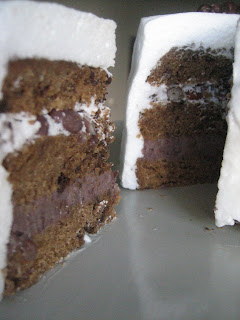
So I made a mini chocolate cake and I steamed it in my good "old" bamboo-steamer (so Chinese). When done I filled it with red bean paste and Italian meringue mixed with whole and chopped red beans. And the cake was covered with a thick layer of Italian meringue. Happy Birthday Blog Quesadillas!

Chocolate cake with red beans and Italian meringue
1 egg
1 dl + 2 tbsp of sugar
10 gr of butter
30 gr chocolate, divided in 2 equal parts
2 tbsp milk
1 tsp vanilla
1 dl + 1 tbsp flour
1/2 tsp baking powder
bit of salt

2 egg whites
1 dl sugar
1/2 dl water

1 dl red bean paste
1/2 dl whole red beans

a mini cake pan, 10 cm in diameter

Melt the butter and half of the chocolate, add milk and vanilla. Grate the rest of the chocolate as small as possible. Beat egg and sugar until pale and thick. Add butter mixture. Mix flour, salt and baking powder and add carefully to the egg mixture. Blend in almost all grated chocolate, leave some for the top. Pour the batter in the cake pan, sprinkle some chocolate on the top and steam on high heat for about 15-20 minutes. When it is done it looks like this:

The best thing about steamed cakes is that it very hard to end up with a dry cake. When you bake in oven sometimes a couple of minutes can make a difference, but when steaming you really have to work hard to end up with a dry cake. I like a lot!


To make meringue start with the sugar syrup. Mix water and sugar in a pan and boil until it gets a consistency of a syrup, 2-3 minutes. Beat egg whites until stiff peaks form and add slowly hot syrup. Beat until meringue is cool and stiff, at least 10 minutes, by hand.


Thursday, May 22, 2008

At a market in Shanghai

I love food markets. I can easily spend hours walking around and exploring. Especially when you are not familiar with many of the things sold there, like here in Shanghai.
Food markets here are just amazing, you can find just about anything. They are very similar to the markets in south of Europe in the way that it is all about seasonal and local. Below you can see just a few of the things you can find at a Shanghainese market.

It looks like cheese but is not. It is tofu...in all kinds of shapes, textures, colors and sizes.

However a warning must be issued for the "stinky tofu". It is a tofu that is fermented in some kind of special brine which makes it smell worse than rotten. I cannot even explain how bad it smells. It is usually sold on streets deep fried. The name it self "stinky tofu" is a direct translation from Chinese.


All kinds of cucumbers.


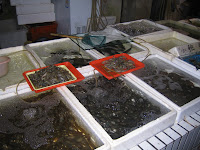
All kinds of clams.


Chinese aubergine is thin and it has very delicate meat. The skin is very thin so you do not need to peel it.


All kinds of bean sprouts.


Noodle "factory" at the market. This reminds me of small tortilla "factories" you can find at Mexican markets.


Yes these frogs are very alive. Sold both at markets and supermarkets.


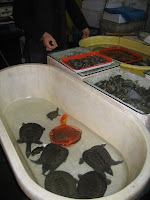
Same applies for turtles. Just minutes after this picture was taken a guy behind the counter slaughtered one with a pair of scissors. Looked VERY cruel.


All kinds of shrimps.


Fresh bamboo shoots.


Red beans, mung beans, lotus seeds, corn seeds, jujube dates, rice, sesame, flour, soy beans, peanuts, dried longan...just name it!


Ground black sesame is used for cakes, cookies.


Jelly fish...


Pork is the most consumed meat in China.


Another creature of the sea...sea cucumber.


Lotus root.


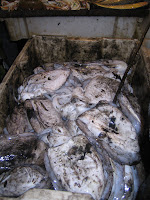
Squid


Water chestnut, peeled and unpeeled. Note the perfectly arranged pak-choy in the right corner.


Mushroom with a funny name: chicken feet mushroom.


Vegetables. Note the VERY long green beans next to the tomatoes.


Wednesday, May 14, 2008

China is mourning

On 12 May south-western part of China was hit by a devastating earthquake that took the life of many people and left the life of the ones who survived in ruins. Help will be needed for many years to come in order to restore the life of the ones who survived. Please contact your Red Cross office to see how you can help or make an online donation.

Saturday, May 10, 2008

THE sweetest museum

I have visited the sweetest museum...ever...it is called Taiwan Nougat Museum. Yes, it is a museum in Taipei dedicated to nougat!

The museum is situated in the nougat factory it self and if you are lucky enough (I wasn't) your visit will be at the same time when there is a factory tour that includes "do-it-yourself" activities. I only got to see the nougat museum and the shop that is attached to it.

Production of nougat started in 1956, after it was introduced from Hong-Kong by Ms Chiu Peng Yu-Ho. In the museum, which is very small and free of charge, you can see a nougat production line that is from way back in time.


You can also see the world's biggest piece of nougat (according to Lonely Planet) and it is all covered in gold. The staff didn't speak English so I never found out if it really was nougat or just a big piece of plastic.

The factory also makes other types of cookies, like Chinese wedding cookies and different types of western cookies. The package of the wedding cookie below says: "It is difficult to know at what moment love begins; it is less difficult to know that it has begun". Sweet!

There is also a room dedicated to all different types of typical Chinese cake molds, like cake molds for moon cakes. An entire wall was covered with those, looked really beautiful!

Last but not least, I bought some nougat in the shop and it was chewy and sweet as nougat should be. What was new to me was that it is made with peanuts. I liked it!

Saturday, May 03, 2008

Lotus root

Lotus is a water plant and many parts of it are used in Chinese cooking. Lotus root it self is the root of the lotus plant and it is growing in the soil of the river bottom. It is the most beautiful looking edible plant I have ever seen. The root can be eaten raw or cooked, it is crispy, tastes delicious and is VERY healthy!


The most common way of preparing lotus root is in soups, stir-fries and candied lotus root filled with sticky rice. The later one is served on the New Years Dinner where candied lotus root symbolizes sweet relationship between husband and wife and sticky rise means they will stick to each other. How sweet!

I found a recipe called "Stir-fried lotus root slices" in the cookbook called "Revolutionary Chinese Cookbook: recipes from Hunan province" written by Fuchsia Dunlop. It is a REALLY good book with lots of wonderful authentic Chinese recipes. I adapted the recipe by using one whole lotus root without breaking apart the sections.